THE HISTORY OF BIATHLON IN THE CHINESE MULTIMODAL
CANOE - DRAGONS
In the autumn of 2016 in Moscow on the rowing channel, I first watched the World Rowing Championship on "dragons". As in international canoeing competitions in the stands, only athletes, coaches, officials, rare relatives and friends of Russian athletes were sitting as spectators.
КIt would seem that the drums are rattling, the sprays are flying, the bared faces of the evil dragons that are mounted on the nose of each boat, have furiously rushed from start to victory - the spectacle is impressive, but there are no spectators.
After several races I draw attention to the fact that the fierce struggle is only the first 40-60 meters, and then continue to actively fight only 2-3 first teams, which, according to the rules, retain the chance to get to the next stage of the competition. Why do the rest of the team after the starting segment do not even try to catch up with the leaders, although there is still a large part of the distance ahead. In almost every race at sprint distances, the first teams at the finish line were the ones who were leading at 40-60 meters.
It turns out that the dragon, along with ten oarsmen, a drummer and a helmsman, weighs an average of one and a half tons. When the oarsmen from the start disperse this machine to the maximum speed, then the dragon is such a wave that the catching up team to drag through it a ton of tons, you need to expend so much power that the race does not continue to have meaning. And given that the distance between the dragons is only about 10 meters, then overtaking the teams walking along the adjacent tracks is stupid.
That is, this competition is only for the fastest start.
But in races for long distances dragons have options, but viewers from afar do not consider them.
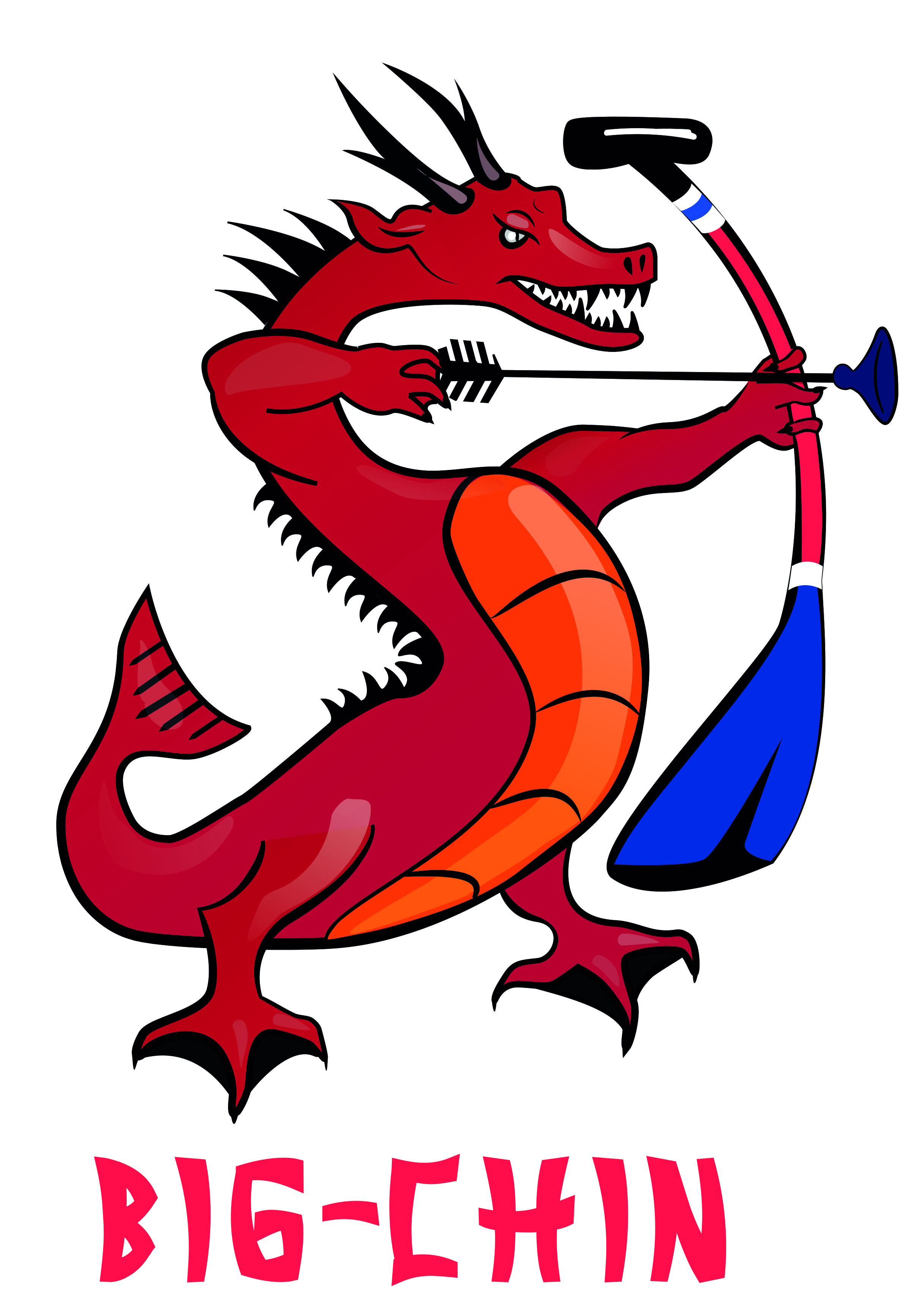
Trying to make rowing on dragons more intriguing and telegenic, I came up with biathlon on dragons. The rules of the dragon biathlon competition can be seen below on this page. They, as well as the logo with the mascot of the International Biathlon Dragons Federation (FIDB) are registered in the Library of Congress as my intellectual property 03.04. 2017
(
view the document).
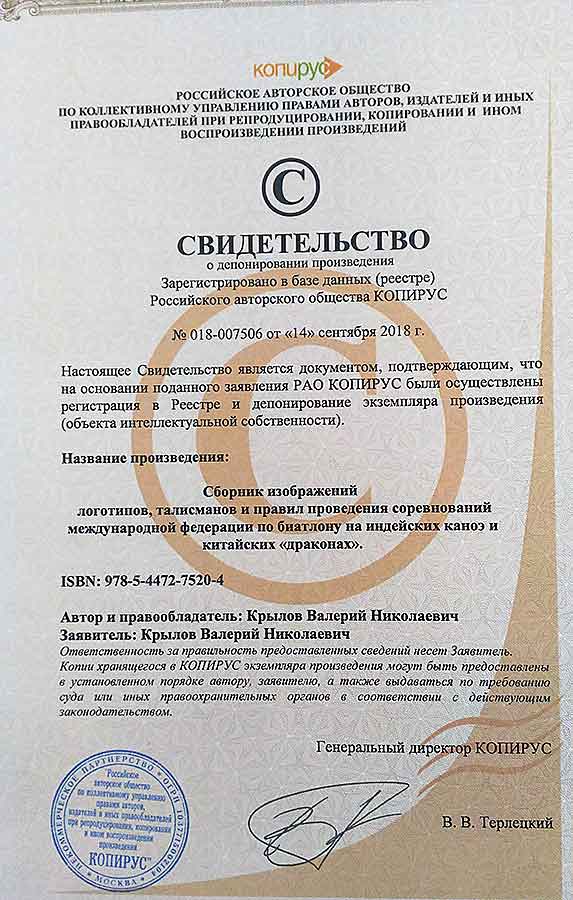
This certificate № 018-007506 (
view the document) confirms that on September 14, 2018, the Russian author's company KOPIRUS registered and entered into the Register of Intellectual Property Objects a set of logos, talismans and rules of the competitions of the International Biathlon Federation on Chinese boats "dragon" and on indians canoes. ISBN: 978-5-44-72-7520-4. Author and copyright holder: Valeriy Krylov. Applicant: Valeriy Krylov
That's the whole story of biathlon on dragons, but it's still going on.
Many canoeists probably re-start the saying: "Who is talking about, and the chicken is all about pshena" to the new edition: "Who is what, and Krylov is all about biathlon."
You are right, gentlemen, but hurry to take up the queue for porridge from two types of biathlon, you will like it. I am waiting for you.
RULES OF COMPETITIONS IN BIATHLON ON "DRAGONS"
Dragon Biathlon is a biathlon consisting of rowing on dragons (Chinese multi-canoe) with simultaneous archery. Competitions are held in three categories - among women's, men's and mixed teams (three women and three men). Regulations on competitions can provide (as in tennis tournaments ATP and WTA) the participation of international crews formed by agreement of athletes from different countries. The competitions can be held on rowing canals and any lakes with smooth water. As can be seen in the DRAGON BIATHLON FEDERATION INTERNATIONAL logo submitted for registration, the dragons' crews consist of seven athletes. The logo also shows that three of them are located along one side, three others - along the other side, and the helmsman - at the stern. The distance of the competition consists of three circles of rowing on dragons. Each circle is 500 meters. The total length of the distance is 1500 meters. In each race, no more than two boats participate, the distance between which is determined by the regulations for each particular competition. The judging panel determines the pairs of teams and the sequence of the races in which these pairs will start. After the first round of rowing, each dragon moored to his raft, which is a firing line for archery. Three riders close to the raft lay oars and hold the boat at the raft. Three distant from the raft of the athlete lay oars, take from the dragon their bows and five arrows each. Each shooting athlete from 18 meters must hit five arrows with four targets with a diameter of 18 cm. Each shooter without a misses his fifth arrow has the right to hit any target that his team-mates failed to hit with the fifth arrow. The target is considered to be affected, IF it fell. Having finished the shooting, the athletes put bows in the dragon, take their oars, and the team goes to the second round of rowing, where it is waiting for a penalty turn for the amount of misses in the shooting. If both teams hit all 12 targets, then both of them pass a turn around buoys with the number "0". If the team could not hit from one to six targets out of 12, then it passes a penalty turn around the buoys with the number corresponding to the sum of its misses. If the team could not hit more than six targets in one of the two series of shooting, then it is removed from the race and included in the consolation race, getting another chance to break into the final of the competition. The distance between the free turns is 20 m. The second circle of the team's distance passes in the form of a lying eight to make their dragons come to their rafts with the other side, and already another three rowers could shoot from the bow. At the third round of the rowing distance, the team is fined for misses in the second series of shooting under the same conditions, after which it goes to the finish line. The winners of all pair races pass to the next stage of the competition, where the same half of the strongest teams are also revealed in doubles. And so before the identification of the four most powerful teams from the number of teams that did not have any defeats. All teams that lost their first race, in the same way, select four strongest teams, which on equal terms with the four strongest teams that do not have defeats pass a draw that defines pairs of eight strongest teams of the competition. Further, each losing team is finally out of the competition. Thus, the team that won the final race is declared the winner of the competition.
More information about the author of biathlon on «dragons».